Sync your availability between Guesty and external calendars, such as Google Calendar or other booking channels, to keep your schedule centralized. Syncing calendars lets you view reservations from channels that don't integrate directly with Guesty to help prevent double bookings.
You can sync calendars through a direct integration or an iCal connection.
Calendar updates typically sync within one hour. To make retroactive adjustments, remove the connection between the calendars and start over with your specific changes.
Important:
Guesty calculates reservation blocks differently from some channels and includes check-in and check-out dates in the reservation block. Always check your dates after syncing. If the dates are off by a day, toggle on Adjust imported events as described in the steps below to fix them.
Prerequisites and limitations
- To prevent duplicate events, use either an iCal connection or channel integration, but not both simultaneously.
- To sync Google Calendar events with Guesty, confirm that your calendar uses a public address and that event access permissions are set to public. Refer to Google's documentation for more information.
Before syncing the Guesty calendar with an external calendar, read the following channel limitations.
Channel limitations
Review the specific limitations for the channels below.
Airbnb
Don't use iCal if the listing is connected to Airbnb, as this causes data discrepancies. If you import a listing from Airbnb, the iCal link automatically disconnects, and any notes are removed.
Vrbo
Users with a full sync connection type:
- For the best experience, use Vrbo's direct integration instead of iCal. The direct integration provides centralized management and maintains data accuracy.
- If you prefer to use iCal, export your Guesty calendar first. Then, import the link to your Vrbo account to sync the calendars.
Users with a limited sync connection type:
- To mitigate sync delays and prevent double bookings, export your Guesty calendar and import it to your Vrbo account. Then, sign in to your Vrbo account and navigate to the calendar settings for the relevant listing. Look for an option labeled "Import calendar" or "Calendar sync", and paste the URL you copied from Guesty.
- A calendar conflict displayed with a red tag in your connected Vrbo account is expected behavior and doesn't affect bookings or availability.
Configure the following required settings for Vrbo iCal in Guesty:
- Importing Vrbo iCal in Guesty: Toggle on Adjust imported events. Leave the "Adjust exported start date" empty. Under "Adjust exported end date", select One day before exported end date from the dropdown menu.
- Exporting Guesty calendars to Vrbo: Toggle off Adjust imported events.
Export your Guesty calendar as an iCal
Export your listing's calendar to share your availability with external channels. This creates a link you can paste into external calendars.
The export covers a date range from one day in the past to two years ahead. Within that range, it includes:
- Manual blocks
- Confirmed & reserved reservations
- Smart Calendar Rules
- Rental periods (unavailable by default)
- Booking window
- Advance notice
- Annual block limit (yearly night limits)
- Preparation time block
Follow the instructions below to export the Guesty calendar to your iCal.
Step by step:
- Sign in to your Guesty account.
- In the side navigation menu, click
 Properties overview.
 - Click the relevant listing.
- In the submenu, click Calendar.
- Select Calendar sync (iCal).
- Next to "Export your Guesty calendar", click Export Guesty calendar. If you previously generated a URL, click Edit.
- Under “Guesty iCalendar link”, click
 to create a URL.
 - Click
 to copy the URL.
 - If the dates require adjustment, toggle on Adjust exported events. Select the relevant options from the dropdown menus under "Adjust exported start date" and "Adjust exported end date".
- Click Save.
Import and sync an external calendar with Guesty
Import an iCal link to view reservations from other channels directly in your Guesty Multi-calendar. Imported current and future reservations appear as gray blocks labeled "Calendar sync (iCal)".
How imported reservations function
- They act as flexible blocks, allowing you to create a Guesty reservation over them.
- They don't trigger Smart Calendar Rules.
- These blocks are placeholders to prevent double bookings, but they are not editable.
- You can't modify them, add notes, or update guest details
Importing an iCal is a one-time action. To continuously sync your calendars, activate calendar syncing after the import. You can add up to ten import links per listing.
If an import creates a double booking, remove the connection, resolve the conflict, and start over.
Note:
Third-party protection tools (like Cloudflare) may prevent the iCal import. Disable the tool temporarily until the import is complete.
Follow the steps below to import your iCal to Guesty.
Step by step:
- Sign in to your Guesty account.
- In the side navigation menu, click Properties overview.
- Click the relevant listing.
- In the submenu, click Calendar.
- Select Calendar sync (iCal).
- Next to "Import external calendars", click Import calendar. If you've already imported one, click Edit.
- Click Add an iCalendar link.
- Under "External iCalendar link", enter a name in the "Name" field and paste the iCal URL in the "External iCalendar link" field. You can update the name and the link anytime.
- Toggle Sync calendar on to activate continuous syncing.
- If the dates require adjustment, toggle on Adjust imported events. Select the relevant options from the dropdown menus under "Adjust imported start date" and "Adjust imported end date".
- Click Save.
Syncing status
After syncing, check the status next to the calendar name:
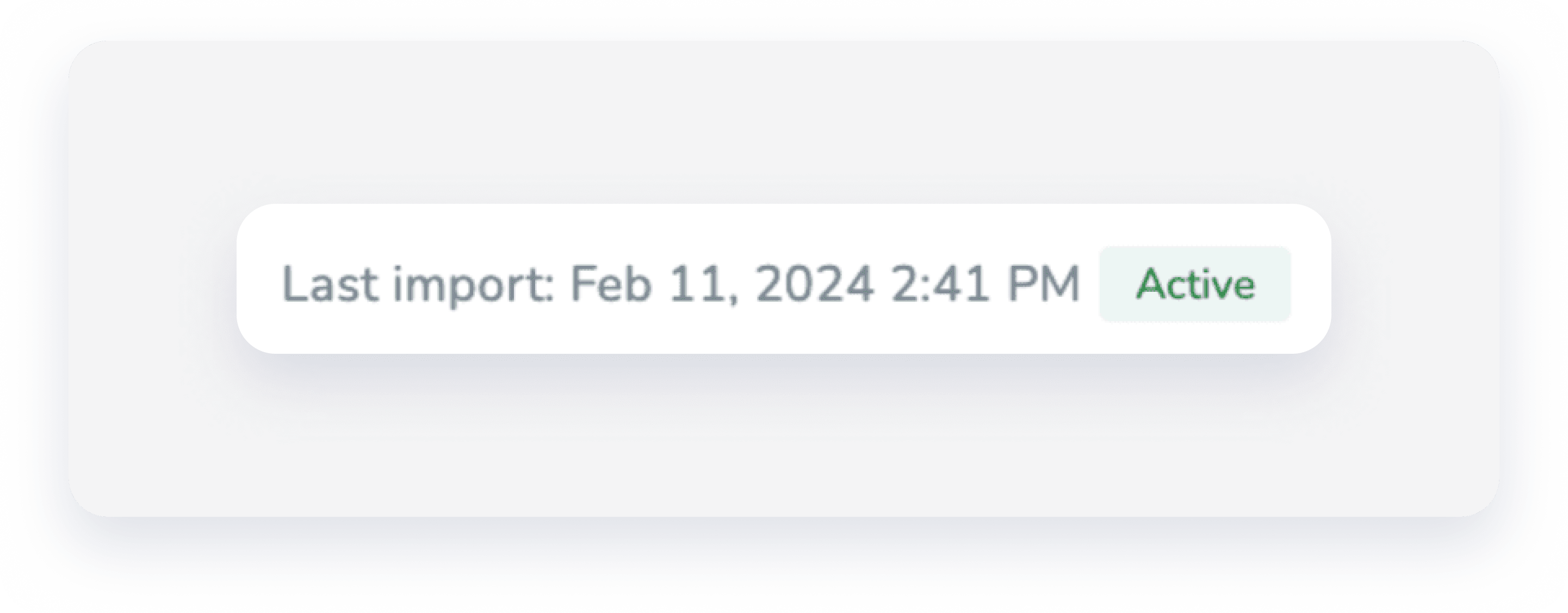
- Active: The sync is working correctly.
- Warning: The import failed. Guesty will retry for 24 hours. If successful, it changes to "Active." If it fails repeatedly, it changes to "Paused."
- Paused: The import failed for over 24 hours. We recommend that you disconnect and reconnect the iCal link.
If the status is “Warning” or "Paused” for over 24 hours, we recommend that you disconnect and reconnect the iCal link.
If you encounter issues, check our troubleshooting guide.
